For adults who've studied Spanish but still can't speak it:

Turn the words you know into words you can speak.

Studied for years and still can't speak? It's the Recognition Trap.

It's not your fault. Apps, videos, flashcards and classes mostly train you to recognise Spanish, and count that as progress. But understanding and speaking are separate skills, and each grows only from its own practice. You didn't fail: you trained the other skill.

You understand far more Spanish than you can say. What you understand What you can say the gap Cuéntame closes

You've probably tried most of these.

Listening and videoBuilds your earWords stick slowly, and hearing a word doesn't teach you to say it
ReadingGrammar and nounsYou still aren't saying anything
Grammar and flashcard appsOften the best designedYou tap answers; you don't speak
TutorsReal conversationA mistake gets fixed once, then nothing brings it back

And each one counts something different: streaks, cards reviewed, "known words", hours watched. None of them counts what you can say, so you can't see the gap, let alone close it.

Where do your Spanish minutes go?

Speaking is what builds speaking. Drag to see how many minutes a week each way of learning actually has you talking.

Watching and listening 0 min speaking a week
Reading 0 min speaking a week
Grammar and flashcard apps 0 min speaking a week
A group class 0 min speaking a week
A tutor 0 min speaking a week
Cuéntame 0 min speaking a week

These are typical splits of the time, not measurements of results. Videos, podcasts and reading are listening or reading time. Apps and cards are tapping and recalling. A class assumes ten learners sharing the speaking, with the teacher talking about half the time. A tutor assumes you talk half the lesson, and that you could see one for that long every day. A Cuéntame session is about ten minutes, with roughly six spoken: your talk, the warm-up and your fixes said aloud. Why speaking time matters: practising producing a language builds producing it (DeKeyser & Sokalski, 1996; Shintani, Li & Ellis, 2013).

I hit the same wall.

I tried everything: gamified apps, reading platforms, video courses, subtitle tools, flashcards. I understood more every month. I still couldn't hold a conversation.

The thing that finally worked was simple. I started talking to an AI in Spanish, about my day, and asked it to correct me and drill me on my mistakes. Say something, see what's wrong, practise it, say it again. For the first time the words I knew started coming out of my mouth.

So I studied what the research says turns understanding into speaking, and built that loop into one place where your Spanish lives. That's Cuéntame.

— The founder of Cuéntame

Know-to-Say: how a word you understand becomes a word you say.

1

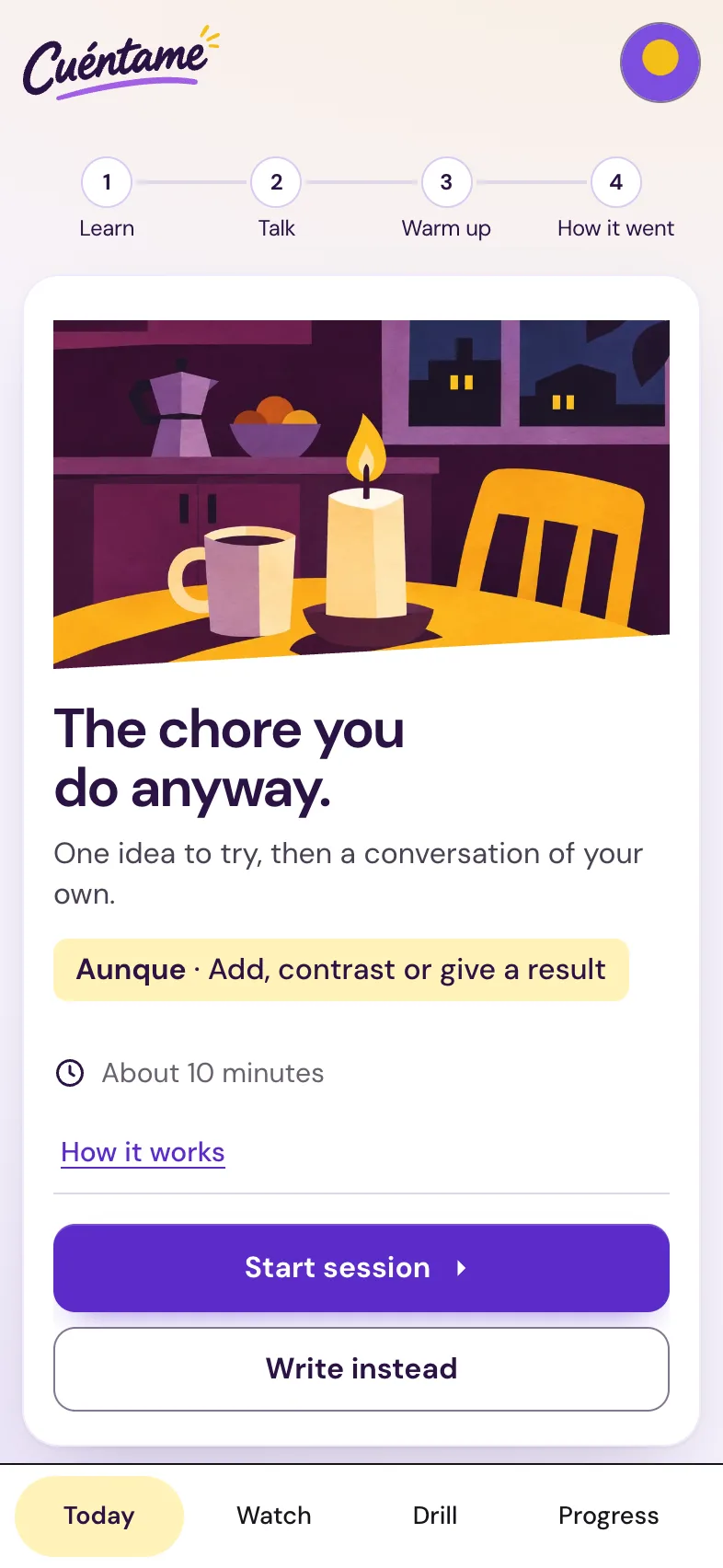
Four moves, about ten minutes a day

  • Meet one idea, because new words stick by meeting them in Spanish you understand.
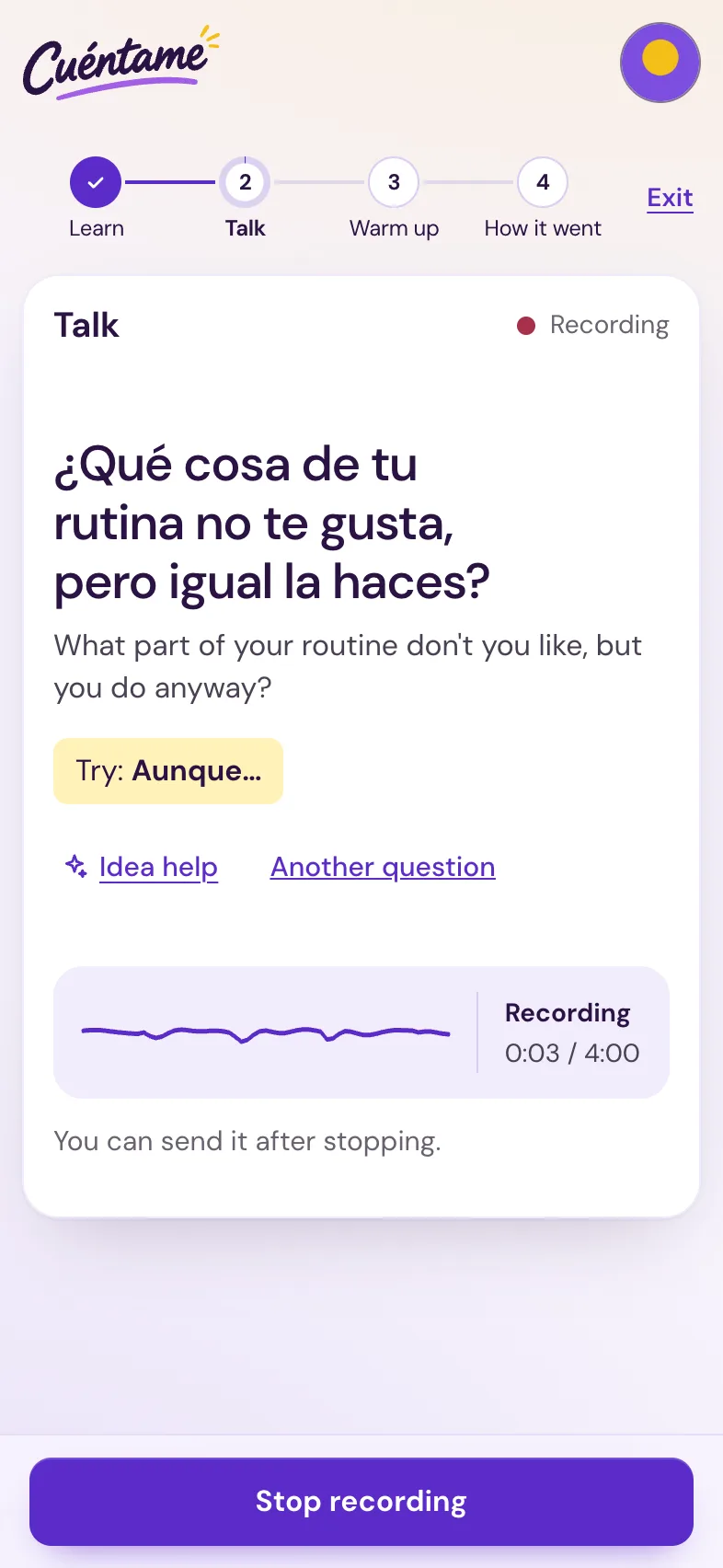
  • Say it: talk for up to four minutes about your own life, because the skill you practise is the one that grows.
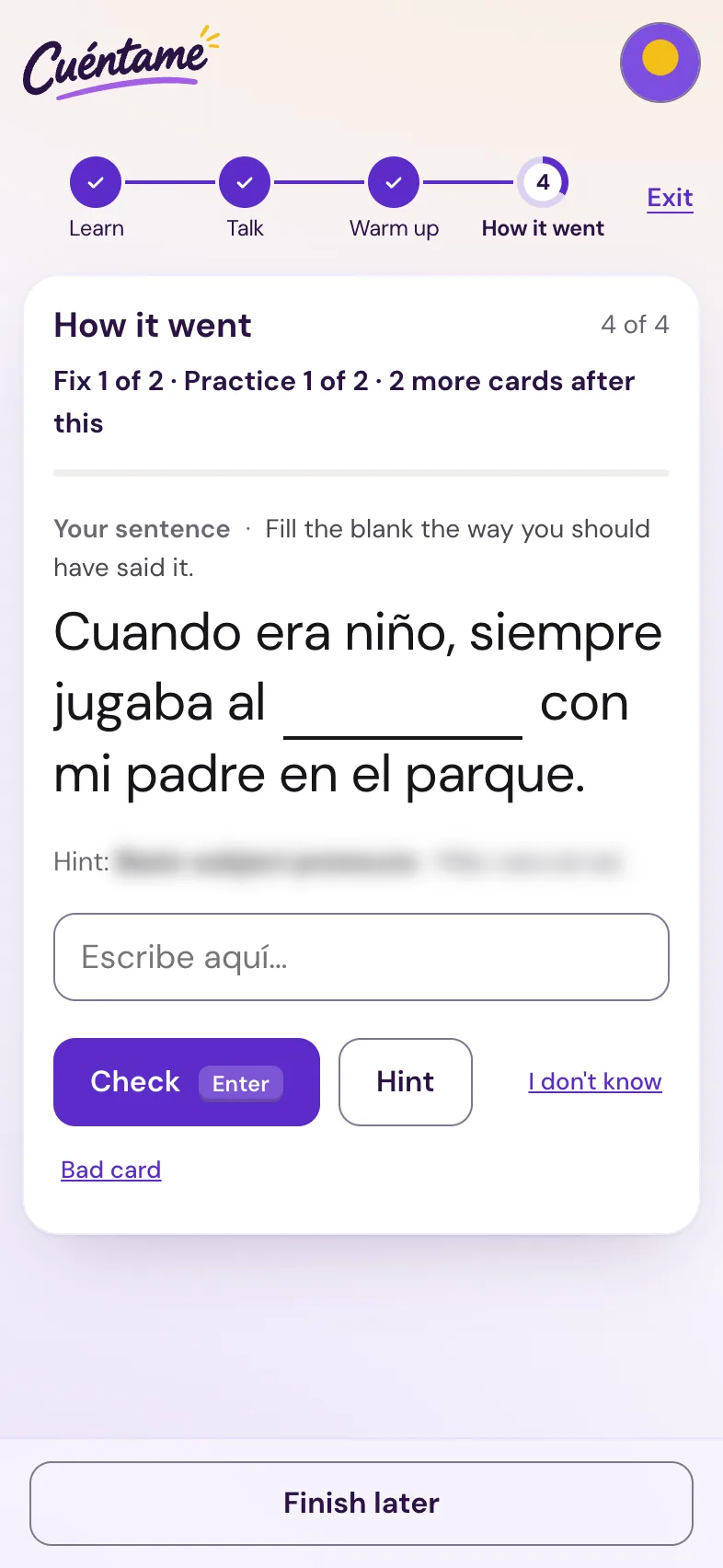
  • Fix the few mistakes that matter, because a wrong try followed by the right answer still teaches you.
  • Return to them over the next days, mixed, because recalling beats re-reading, and a night's sleep helps new words stick.

2

The Say Ladder

Every word you meet sits on one of five rungs: recognised, practising, said with help, said on your own, solid. Watching and drilling count, but only speaking moves a word to the top three. So you always know what you can actually say, measured against a curriculum built on the CEFR and the Instituto Cervantes' plan for Spanish.

Coming soon: bring your Anki decks and course word lists.

Less time in an app, more Spanish in your mouth. And your tutor time becomes what it should be: conversation, not lessons.

See what a session gives you back.

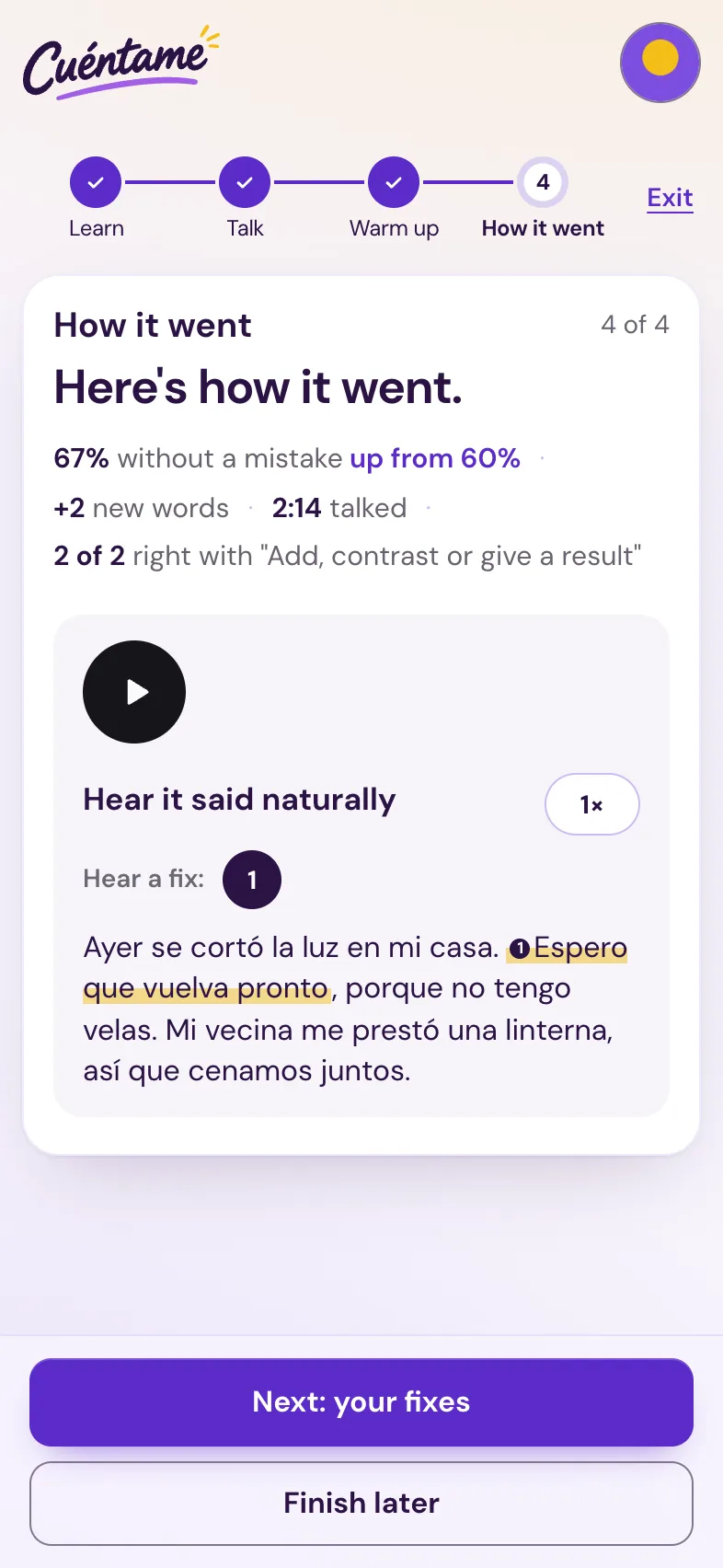
You talk. Cuéntame writes down exactly what you said, reads it back the way a native speaker would say it, and gives you the few fixes that matter.

Yesterday at the beach

19 words · 2 fixes

You said

Ayer fui a la playa con mi hermana. Fue muy divertido porque hace sol y el agua estaba perfecto.

The way a native speaker would say it

Ayer fui a la playa con mi hermana. Fue muy divertido porque hacía sol y el agua estaba perfecta.

Win back 1 of 2 won back

  • porque hace sol → porque hacía solThe weather in a story about the past takes the imperfect.
  • el agua estaba perfecto → perfectaAgua is feminine. It takes el only because it starts with a stressed a.

Built on research, not hunches.

We checked more than 200 research sources on how adults learn languages and kept only what holds up.

  1. Understanding and speaking are separate skills. Each grows from its own practice.
  2. Hearing a word doesn't teach you to say it. Words from listening and reading stick a little at a time, and in a study of new Spanish words, only learners who had to say them learned to use them.
  3. Saying a word is what makes it yours. Learners who had to produce new words could use them; hearing them wasn't enough.
  4. Trying to recall beats re-reading. Even a wrong guess helps a word stick.
  5. Spacing and mixing beat cramming. Practice that returns over days, mixed, lasts.
  6. Sleep helps new words stick. That's one reason your fixes come back the next day, not the same hour.

"But…"

"I'm not ready to speak yet."
You don't have to be. Use English for any word you don't know; Cuéntame gives you the Spanish for it. Every session starts with a short idea before you talk.
"I don't have time."
A session is about ten minutes, and you can stop after any step. Your work is saved.
"I already have a tutor."
Good. Cuéntame does the word work between lessons, so your time with your tutor is real conversation.

You understand it. Now say it.

Start free. No password: you sign in with a link, then Face ID or your fingerprint.

Cuéntame
Daily goal …


Blocky illustration of a candlelit kitchen table at dusk.

…

You can send it after stopping.

La carta de hoy

Watch

Videos from your channels, with the transcript beside them.

New from your channels

Other videos you've opened

Drill


Loading…

Progress


Words spoken per week

Accuracy per 100 words

Where you are

    Your map

    Loading…

    What keeps coming up

    Loading…
    See all patterns

    Words by topic

    Share of each topic's words, up to the band after yours, that you've used correctly.

    Loading…
    See all topics